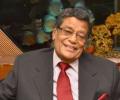
Senior advocate K K Venugopal's name has been cleared for appointment as the Attorney General for India, following the decision of Mukul Rohatgi to step down as the top law officer.
His present three-year term ends on Tuesday.

Rohatgi was the country's attorney general from June 2014 to June 2017.

He will succeed K K Venugopal, whose term will end on September 30.
Venugopal, who is the recipient of Padma Vibhushan and Padma Bhushan, is likely to represent as the top law officer for the second time, as he was one of the Additional Solicitors General during Morarji Desai's government.

Two lawyers on Monday wrote separate letters to Attorney General K K Venugopal seeking his consent to initiate contempt proceedings against Rajya Sabha MP and senior advocate Kapil Sibal for allegedly making statements "scandalising" the verdicts delivered by the Supreme Court.

The contempt petition refers to the February 1 tweets by Bhushan in which he had allegedly said that the government appeared to have misled the apex court and perhaps submitted fabricated minutes of meeting of the high-powered selection committee headed by the prime minister.

AG is of the view that there is no point in dragging the matter further when it has already been "struck down" by one international forum, and also by the top Indian court.
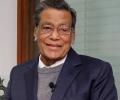
Senior advocate K K Venugopal has agreed to continue as the attorney general for India for three more months following a request by the central government, government sources said.
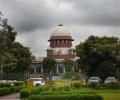
Three academics involved in drafting a controversial NCERT textbook chapter on corruption in the judiciary have approached the Supreme Court to defend their work, stating it was a collective effort and not the view of any single individual.

The top court also issued a notice to Attorney General R Venkataramani asking that either he or Solicitor General Tushar Mehta assist it in the hearing. The court will now hear the Kerala government's plea on Friday.

Venugopal further wrote: "The depiction of the two fingers, with the legend that he means the middle one, is to deliberately insult the Chief Justice of India which would equally be an insult to the Supreme Court of India itself, which the Chief Justice heads."
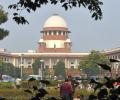
The Supreme Court is hearing arguments regarding a presidential reference on whether fixed timelines can be imposed on governors and the president for acting on bills passed by state legislatures. The court is considering objections to the maintainability of the reference under Article 143 of the Constitution.

His second term as solicitor general was renewed recently.
Venugopal told the court that he had given legal opinion to the AIADMK faction led by Panneerselvam.

Attorney General K K Venugopal has refused his consent for initiating criminal contempt of court proceedings against Bollywood actor Swara Bhaskar for her alleged 'derogatory and scandalous' statements against the Supreme Court over the Ram Janambhoomi-Babri Masjid case verdict.
The Supreme Court has initiated a suo motu case regarding investigation agencies summoning lawyers and will examine if they can be put to notice. The action follows the Enforcement Directorate summoning senior lawyers, which was condemned by bar associations.
The Supreme Court addressed the issue of probe agencies summoning lawyers for providing legal advice to clients under investigation, emphasising that lawyers should not be summoned merely for offering legal advice but can be if they are assisting in the crime. The court is considering guidelines to prevent investigative overreach and protect lawyer-client privilege.

The Supreme Court expressed serious concern over the Enforcement Directorate summoning advocates for offering legal advice or representing clients during investigations, calling for guidelines on the matter.

The Supreme Court of India has agreed to hear on May 6 the pleas of the Kerala government against the governor over the delay in approving bills passed by the state assembly. The court will consider whether the issues raised in the Kerala petition are covered by a recent judgment on a similar plea by Tamil Nadu, which set timelines for governors and the President on granting assent to bills.

He now claims that his submission before the SC was that petitioners in the application used "photocopies of the original" papers, deemed secret by the government.

'Considering the fact that the Attorney General for India has already declined to grant his consent in the present matter for the reasons detailed in the said letter...the present request made to me is misconceived,' Mehta said in his letter addressed to lawyer Anuj Saxena.

The Supreme Court, which quashed the controversial skin-to-skin judgment of the Bombay high court in a case under the POCSO Act, said on Thursday that this was the second instance where the attorney general filed an appeal on the criminal side challenging a high court order.
"Today, I am quiet because the attorney general has sought a very short time, next time I will not be quiet. Use your good office to see these issues are resolved," Justice Sanjay Kishan Kaul told Attorney General R Venkataramani. "I thought of saying a lot, but since the attorney general is only seeking seven days time, I'm holding myself," said Justice Kaul, whose bench also comprised Sudhanshu Dhulia, after Venkataramani sought a week's time to come back with instructions on the pending recommendations for judges' appointment to the high court.
A Constitution bench comprising Chief Justice B R Gavai and Justices Surya Kant, Vikram Nath, P S Narasimha and A S Chandurkar, would fix the timelines on July 29 and commence hearing on the presidential reference in mid-August.

Venugopal said today people believe that they can 'boldly and brazenly condemn' the Supreme Court of India and its judges by exercising their freedom of speech, but under the Constitution, the freedom of speech is subject to the law of contempt.
Besides the present CJI Chandrachud, former CJIs Ranjan Gogoi and SA Bobde and former judges Ashok Bhushan and S Abdul Nazeer were part of the bench which had delivered the historic verdict on November 9, 2019.
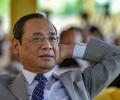
Activist Saket Gokhale had sought consent, a condition precedent for initiating criminal contempt proceedings, of the top-most law officer to initiate the case against the former CJI who had reportedly said at an event that the judiciary is "ramshackled" and it is quite unlikely for a person to get a timely verdict.
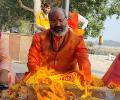
The consent has been granted in response to a letter by an activist, Shachi Nelli, seeking to initiate contempt against Yati Narsinghanand for his statements in an interview that went viral on Twitter on the January 14.

The pleas came up for hearing before a bench headed by Justice Ashok Bhushan which heard the submissions of advocate Nishant R Katneshwarkar, who appeared for one of the petitioners and claimed that Kamra had posted several tweets scandalous to the judiciary.
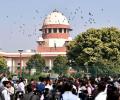
The row over premature retirement of former NCLAT Chairperson Justice Ashok Iqbal Singh Cheema ended in the Supreme Court on Thursday as the Centre conceded, permitting him to continue in office till September 20 to pronounce verdicts.

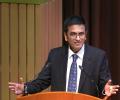
In his address, CJI Chandrachud recounted his journey, from sitting in the last row of the court as a young law student to his time on the revered corridors of the top court.

Chidambaram's jibe came a day after the AG said that the Rafale documents were not stolen.

The Supreme Court on Wednesday posed a slew of queries to the Centre on the grant of 10 per cent quota in admissions and government jobs to the EWS category, saying the "slice of cake" of 50 per cent open general seats available to OBCs above the creamy layer now stands reduced to 40 per cent.
He added that if the Constitutional morality still breathes, first Prime Minister Jawaharlal Nehru's fear that Supreme Court will become the third chamber of Parliament might come true.

The top court, meanwhile, permitted the state government to amend its plea to seek issuance of guidelines for the governors on grant or decline of assent to the bills passed by the assembly in a time-bound manner.

A bench comprising Chief Justice N V Ramana and Justice Krishna Murari took note Attorney General K K Venugopal's submissions that the Centre, besides bringing back stranded students, is also looking into the representation on their studies being hit by the ongoing war.
A plea claimed that Bhaskar had made "derogatory and scandalous" statements against the courts in the country and mentioned the Ayodhya case judgement.

The apex court was hearing a plea by a former woman judicial officer who resigned following an inquiry into her allegations of sexual harassment against a Madhya Pradesh high court judge.

The Guild denounces these threats and urges the government to refrain from initiating any action that might undermine the media's freedom and independence the statement said.
